
 0086-13958366031
 0086-13958366031
An oxygen regulator is one of those devices that disapp […]
An oxygen regulator is one of those devices that disappears into the routine of care. You open the cylinder valve, turn a knob, set a flow rate, and oxygen reaches the patient. Nobody thinks about the parts inside it until something drifts: a needle that will not hold a setting, a gauge that reads strangely, a washer that hisses.
We build oxygen regulators at Yuyao Dengyue Medical Equipment, a factory in Yuyao, Zhejiang that has been making medical gas equipment since 1987. In this article we walk through the parts of an oxygen regulator the way we see them on the bench: what each one does, how the pieces work together, and which small details decide whether a regulator still holds its accuracy after a thousand uses.
Before listing parts, it helps to be clear about the task. A full oxygen cylinder can hold gas at roughly 13 to 15 MPa, or about 2,000 psi. A patient needs a few litres per minute at a pressure low enough to pass safely through tubing, a humidifier or a nasal cannula. The regulator is the device in between, and it has to do four things at once:
Every part described below exists to serve one of those four jobs. Once you see the device that way, the layout stops looking arbitrary.
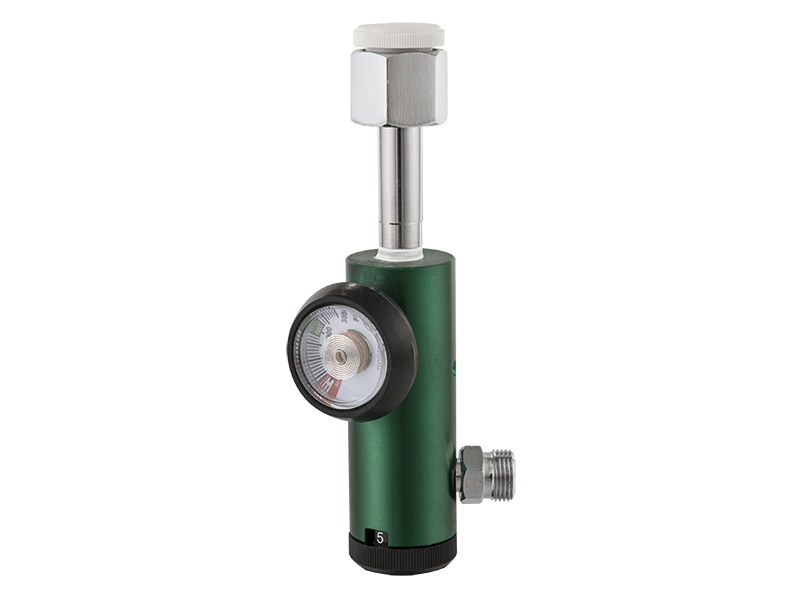
The table below describes a standard cylinder-mounted regulator, which is the most common configuration in home care, ambulance and ward use.
| Part | What it does | What to check |
|---|---|---|
| Cylinder connection | Attaches the regulator to the cylinder valve and seals the gas path | Thread or pin-index standard, washer condition |
| Inlet filter | Traps dust and metal particles before they reach the valve seat | Clean or replace at service intervals |
| High-pressure gauge | Shows remaining cylinder contents in psi, bar or kPa | Scale and units suited to your market |
| Pressure-reducing assembly | Drops cylinder pressure to a stable outlet pressure | Diaphragm material, seat quality |
| Adjustment knob and needle valve | Lets the user fine-tune the delivered flow | Smoothness and repeatability of the setting |
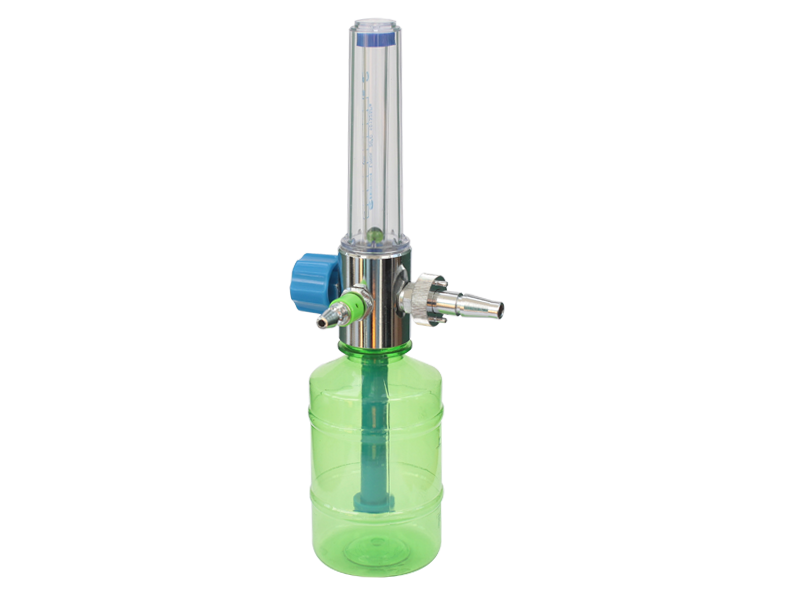
| Flowmeter | Displays the flow being delivered in litres per minute | Range, such as 0 to 15 or 0 to 25 L/min |
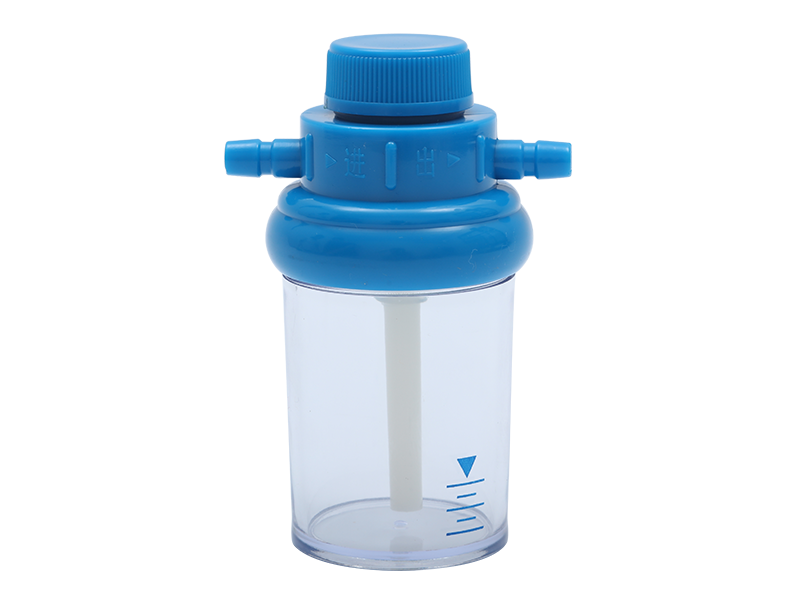
| Outlet port and nipple | Connects tubing, a cannula or a humidifying bottle | Fitting match with your accessories |
| Relief valve | Releases gas if downstream pressure exceeds the limit | Never capped, taped or plugged |
Gas enters through the inlet at full cylinder pressure and meets a small valve seat. A spring pushes against a flexible diaphragm. When outlet pressure rises, the diaphragm moves and the seat closes slightly, restricting flow. When pressure drops because the patient is drawing gas, the spring opens the seat again. The result is a self-correcting loop that holds outlet pressure nearly constant while cylinder pressure falls from full to almost empty.
The diaphragm is where cheap regulators reveal themselves. It has to flex millions of times without hardening or cracking, and it has to be compatible with oxygen service, which means no oils and no elastomers that degrade in the presence of the gas. The seat faces the same demands at a much smaller scale.
Single-stage regulators do the reduction once, in one chamber. They are compact, light and economical, and they are the standard choice for portable cylinders and ambulance kits. Two-stage regulators reduce pressure in two steps, which produces a flatter delivery curve and less variation as the cylinder empties. They are heavier and more expensive, and they tend to appear in clinical settings with steady, higher demand. Neither design is better in the abstract; the choice depends on how stable the flow must stay at the end of a cylinder.
On most cylinder regulators the knob drives a needle valve, a tapered pin that moves into a matching seat. A fraction of a turn changes the opening area, and that changes flow. A well-made needle valve feels progressive: the first quarter-turn should not jump from nothing to full flow. The knob is also the part users judge the whole product by, so a little extra machining attention there pays off in the field.
Two families dominate. A variable-area, or Thorpe tube, flowmeter uses a vertical tube with a float that rises as gas flows past it; the reading is taken at the top of the float. It is simple, easy to service and readable at a glance. A dial-type flowmeter uses a mechanical indicator and is less sensitive to being tilted. Some regulators combine the pressure gauge and the flow indicator in one compact body to save space on a crowded cylinder yoke.
The outlet is where the regulator meets the rest of the delivery chain: tubing, a cannula, a mask, or a humidifying bottle that adds moisture so long-term oxygen therapy does not dry the airway. A loose or mismatched outlet fitting is one of the most common causes of leaks that get blamed on the regulator itself.
When oxygen comes from a hospital pipeline rather than a cylinder, the regulator is no longer the pressure source, because the pipeline is already regulated. The device at the wall becomes a flow control and metering unit: a wall-mounted flow meter with a knob, a flow tube and a standardised outlet. What changes most is the connection. Terminal units are built to British, German or Japanese standards, and the outlet has to match the rest of the ward installation, which is why we produce several terminal families rather than a single universal one.
For hospital projects, the range of the flow meter and the terminal standard usually matter more than any single internal component. If you are specifying for a medical oxygen supply, it is worth reading our guide on how to choose the right wall flow meter for medical oxygen supply before you fix the parts list.
Every regulator should have a way to release excess downstream pressure. If the reducing seat leaks, or if a downstream blockage builds pressure on the low-pressure side, the relief valve opens and vents gas rather than letting tubing or a humidifier bottle fail. It is a small part with a large responsibility, and it should never be capped, taped or plugged to stop a nuisance hiss.
Oxygen cylinder connections rely on a soft washer or an O-ring to seal. A cracked or missing washer produces a leak at the inlet that no amount of knob turning will fix, and it is one of the first things to check when a regulator appears to have stopped working. Inlet filters are equally unglamorous: they protect the seat from particles and dust, and they cost almost nothing to replace during service. For a broader view of the different configurations and their precautions, see our notes on the types, uses and safety considerations of medical oxygen cylinder regulators.
Because we have been manufacturing medical gas equipment since 1987, our view of these parts is shaped by what comes back from service. Our oxygen regulator range covers models such as the DY-540, DY-540B and DY-870, along with the DY-C series, and the same thinking extends to our wall flow meters, gas outlets, oxygen valves, cylinders, accessories and pressure monitoring instruments. The company holds ISO13485 certification, and our nebulizers carry CE marking.
We are a factory rather than a trading company, with an annual capacity of more than 200,000 sets and a team that can develop products from a customer drawing or sample. That matters for regulators, because the parts that fail first are rarely the visible ones. They are the seat, the diaphragm and the washer, and those are exactly where a custom order lets a buyer specify a better material rather than accept whatever is standard.
Do I need a two-stage regulator? If the flow must stay stable until the cylinder is nearly empty, or if the device is used for long procedures, two-stage is easier to live with. For portable and emergency use, a good single-stage regulator is usually the more practical choice.
Why does the flow drop as the cylinder empties? That is the droop characteristic of a single-stage design. As inlet pressure falls, the spring has to work against less opposing force, so outlet pressure shifts slightly. A two-stage design hides most of that effect.
How often should the seat or washer be replaced? Washers are consumables and should be inspected at every cylinder change. Seats and diaphragms last much longer, but they should be checked whenever a regulator is serviced or whenever a unit cannot hold a set flow.
A regulator is a small assembly of ordinary parts doing an unforgiving job. The connection, the filter, the gauge, the reducing assembly, the needle valve, the flowmeter, the outlet and the relief valve each carry one part of the promise that the patient receives the flow that was set. When you know what each piece is for, choosing a regulator, servicing one, or writing a specification becomes a much more grounded conversation, and we are always glad to have it.
 English
 No. 16-18 Dongpu Village, Simen, Yuya, Zhejiang, China
 0086-574-62134031
